



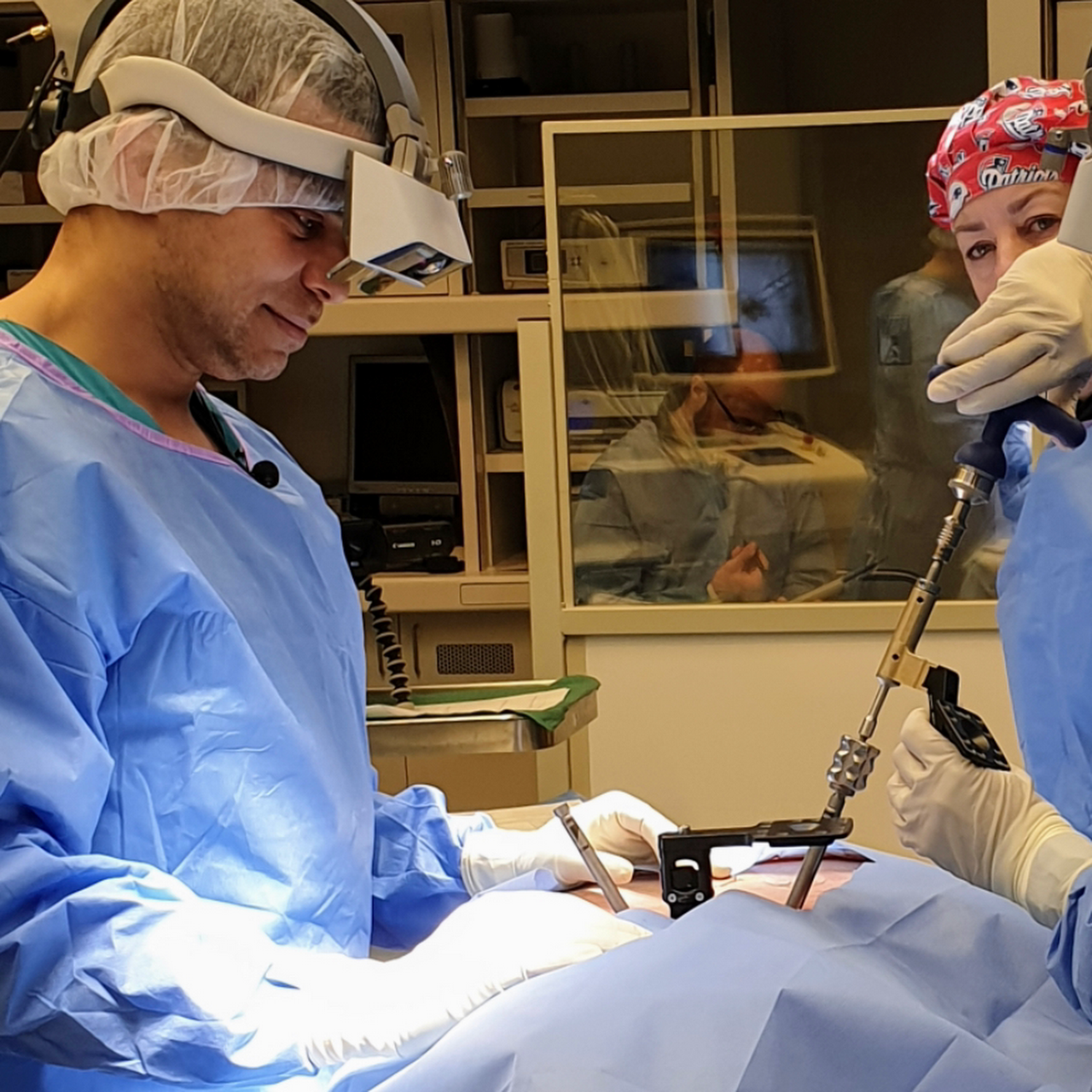
Spine surgery through an incision about the size of a pencil eraser. For the right patient, endoscopic surgery can relieve leg and back pain from a pinched nerve with less muscle disruption, less pain after surgery, and a faster return to normal life than traditional open surgery.
Dr. Kris Radcliff is a fellowship-trained spine surgeon, Professor of Orthopaedic Surgery and Neurological Surgery at Thomas Jefferson University, and part of Progressive Spine & Orthopaedics. Endoscopic surgery is now a growing part of his practice, alongside artificial disc replacement and other alternatives to fusion. He also teaches minimally invasive techniques to other surgeons, including as invited course faculty for the Society for Minimally Invasive Spine Surgery (SMISS) in 2026.
What is endoscopic spine surgery?
An endoscope is a thin tube, about the width of a pencil, with a high-definition camera and light at its tip. Dr. Radcliff passes it through a small incision, usually less than half an inch, and works through it with tiny instruments while viewing a magnified image of the nerves on a monitor. Saline flows through the scope the whole time, which keeps the view clear.
Because the scope slides between muscles instead of cutting or stripping them away, the muscles and ligaments that support the spine are largely left intact. That is the main reason recovery tends to be easier.
Who may be a good candidate
- A herniated (slipped) disc pressing on a nerve, causing sciatica: pain, numbness, or weakness down the leg
- Foraminal or lateral recess stenosis: narrowing where the nerve exits the spine
- Some cases of central spinal stenosis, which can often be decompressed on both sides through a single small incision
- A recurrent disc herniation after a prior discectomy, in selected cases
- Symptoms that have not improved with physical therapy, medications, or injections
When another approach may be better
Endoscopic surgery is a tool, not a cure-all. It may not be the right choice if the spine is unstable (for example, a slipped vertebra that moves), if there is significant deformity, or if several levels need to be treated at once. In those situations, a different operation, such as disc replacement, a minimally invasive decompression, or in some cases a fusion, may give a better result. Choosing the right operation for the right patient matters more than the technology itself, and Dr. Radcliff will walk you through every option, including not having surgery at all. Related: Sciatica and herniated discs | Spinal stenosis | Second opinions
Read more about alternatives to fusion.
Endoscopic vs. traditional open surgery
- Incision: under half an inch, compared with one to two inches or more
- Muscle: spread apart rather than cut or stripped from the bone
- Hospital stay: most patients go home the same day
- Pain after surgery: typically less, with less need for opioid pain medication
- Return to activity: walking the same day, with many patients back to desk work within one to two weeks
Every patient is different, and recovery depends on your condition, your general health, and the work you do.
What to expect
Before surgery: Dr. Radcliff reviews your MRI and examines you to confirm exactly which nerve is being pinched and why. Getting this right is the most important step.
The day of surgery: The procedure is usually done at a surgery center or hospital and takes about one to two hours. You will be asleep or sedated, depending on the case.
After surgery: You will walk the same day. Leg pain often improves quickly, though numbness and tingling can take weeks to months to settle as the nerve heals. You will get a simple activity plan, and many patients start a short course of physical therapy.
Risks
All surgery has risks. With endoscopic surgery they include temporary nerve irritation or numbness, a small tear in the lining around the nerves, infection, bleeding, and the chance that the disc herniates again. Occasionally, surgery needs to be changed to a more traditional approach. Dr. Radcliff will discuss your specific risks with you in detail.
Frequently asked questions
Will I be in the hospital overnight?
Most patients go home the same day.
How soon can I go back to work?
Many people with desk jobs return within one to two weeks. Physical jobs usually take longer, and Dr. Radcliff will give you a plan based on your work.
Is endoscopic surgery the same as laser spine surgery?
No. Endoscopic surgery uses a camera and precise instruments to remove what is pressing on the nerve. Be cautious of advertisements that promise laser cures.
I have been getting injections for months. When should I consider a surgical opinion?
If injections, therapy, and medications are not giving you lasting relief, or if you have weakness in your leg, it is reasonable to find out whether a surgical option makes sense. A consultation does not mean you need surgery.
I was told I need a fusion. Could endoscopic surgery be an option instead?
Sometimes. It depends on whether your spine is stable and what is causing your pain. A second opinion can help you understand all of your choices.
Will my insurance cover it?
Dr. Radcliff accepts most commercial insurance plans and is out of network with most of them. Many Pennsylvania and New Jersey plans have out-of-network benefits, and we can help review your benefits and explain them. Don’t worry. We are all about helping the patients.
Schedule a consultation or second opinion
Dr. Radcliff sees patients in Somers Point, Cherry Hill, and Brick, New Jersey, as part of Progressive Spine & Orthopaedics.
Call: 609-800-3472
Fax: 609-842-4040
newjerseyspinesurgeon.com
Please bring your MRI (the disc and the report) to your visit.
This page is general information, not medical advice. Your treatment should be based on an evaluation by your own physician.